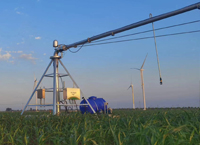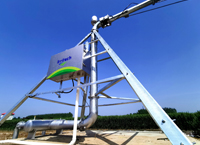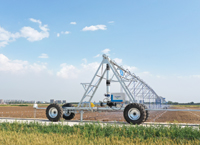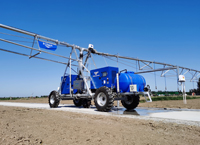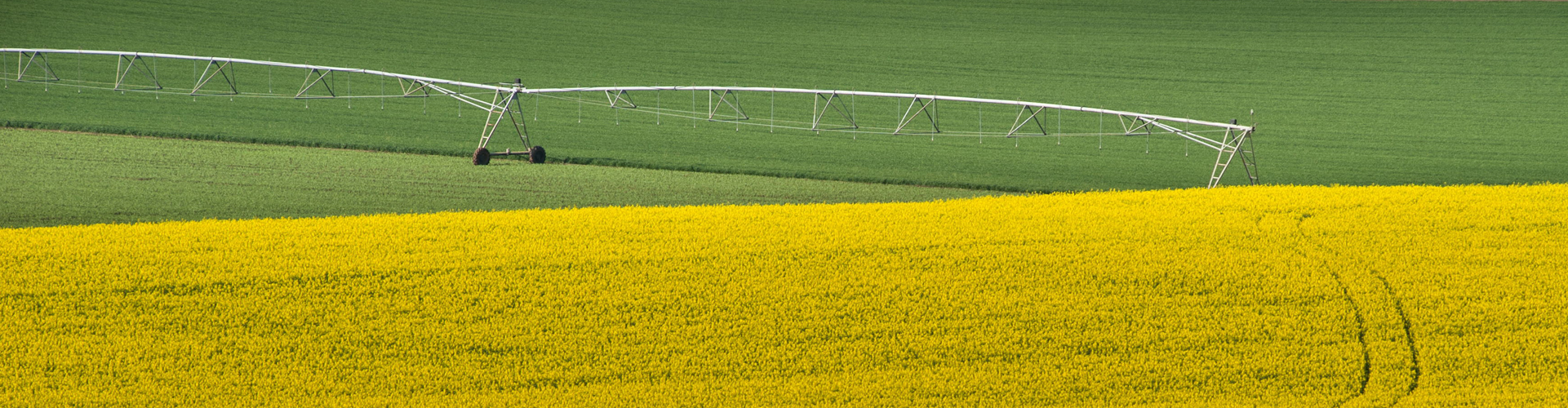
A center pivot or linear machine already moves a large volume of water at working pressure, and fertilizer has to join that stream at one specific place. That place is the injection assembly, the boundary between a tank of mixed solution sitting near atmospheric pressure and a pipe carrying water toward the sprinklers. Separating the hardware by duty — the unit that adds pressure and meters, the valves that keep the branch one-way, and the fittings that hold the tie-in leak-tight — makes a fertigation layout readable. This map covers those parts and the connection logic behind a center pivot nutrient injection system and its linear-machine equivalent.
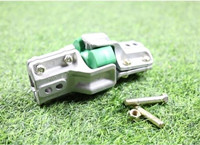
A nutrient injection assembly is a small group of hardware arranged around a single spot on the pipe. The injection unit adds pressure and meters solution into the mainline. The injection point is the tie-in itself: a threaded port, a saddle clamped onto the pipe, or a welded boss. Check valves sit on the injection line beside that port. Isolation valves and unions sit around the pump so the branch can be worked on without draining the machine. Connection fittings — tees, reducers, flanges, hose barbs, and pipe supports — hold the branch together under working pressure. Steel parts in assemblies of this kind are commonly hot-dip galvanized to standards such as ASTM-A123, because the tie-in sits outdoors and stays wet.
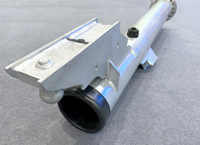
Location does most of the job. The port has to sit downstream of the irrigation pump discharge, because that is where moving water exists, and upstream of the first sprinkler, so every span carries treated water rather than only the far end of the machine. The run of straight pipe between the port and the first nozzle does the mixing, which is why injection ports rarely sit beside an elbow, a valve, or a pressure gauge. Physically, the tie-in is a tapped fitting, a saddle, or a welded boss chosen for the pipe diameter and the working pressure at that position, with an injection line sized to carry solution from the pump into the pipe.
A check valve on the injection line lets solution enter and blocks mainline water from traveling back toward the pump and tank. That one-way behavior protects the pump, keeps the tank from being diluted with raw irrigation water, and stops the feed point from becoming a two-way connection. Many layouts add a second check valve at the pump discharge for the same reason. Isolation valves let a technician close the branch while the machine keeps irrigating, and unions or flanged joints then allow the pump or a valve to be removed, cleaned, or replaced. Together, these fittings turn a fixed tie-in into something that can be calibrated and serviced mid-season.
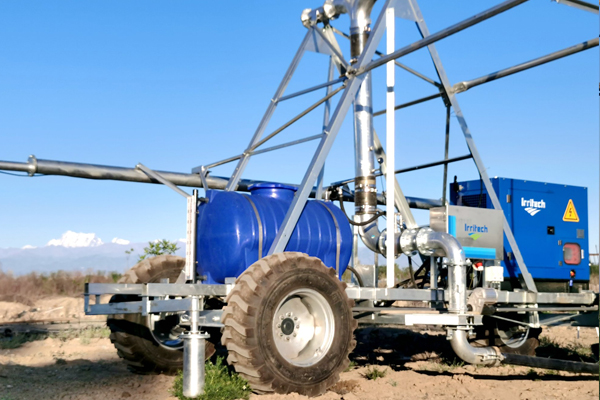
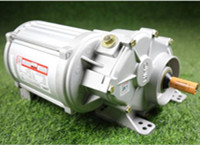
The tank side and the pipe side of an injection assembly sit at very different pressures, and the injection pump is what bridges the two. Solution leaves the tank at or near atmospheric pressure, while the mainline may be holding several bar of working pressure as it feeds the spans. The pump therefore has to develop more pressure than the mainline already carries, or nothing enters the pipe. Positive-displacement designs — piston and diaphragm types — move a fairly consistent volume per stroke, which holds the feed rate steady while mainline pressure shifts with flow changes. Water-driven and venturi devices work from a pressure difference instead, so their delivery follows the conditions across the device. The second relationship is rate against flow. A pivot or linear machine covers ground, and the volume of water passing the injection point changes with travel speed and with how many spans are running. Holding a constant concentration means the injection rate has to track that water volume, which is exactly what calibration is for. University of Arkansas extension material on chemigation calibration walks through the basic arithmetic: measure how much solution the unit delivers in a set time, compare that figure with the water moving through the system, then adjust until the two match. When they line up, the same nutrient concentration reaches every sprinkler. In the field, this relationship is what a technician is watching during a fertigation pass. A walk along the machine usually starts at the injection point: whether the injection line is holding pressure on the downstream side of the check valve, whether the isolation valves are fully open rather than half shut, and whether the tie-in shows any weeping at the threaded or flanged joints. Those observations say a lot about whether the feed point is doing its job, and they cost nothing but a few minutes at the start of a run.
The injection assembly answers two questions: where solution enters the pipe, and at what rate. Other parts of the system and the operator handle the rest. It does not choose the recipe or the target concentration, and it does not decide when in the season a nutrient is applied. It does not create water flow, so when the irrigation pump stops there is nothing for it to feed into. It does not make distribution uniform across the field, since uniformity comes from the nozzle package, pressure regulation, and machine alignment. Nor does it judge whether a particular fertilizer or crop protection product suits the wetted materials in a given build. Pump type, flow rate, pressure range, electrical control integration, and chemical compatibility vary with configuration, so those details are worth confirming against the actual build before a unit is specified.
Read as hardware, injection equipment is a controlled feed point inside a pressurized line rather than a separate machine. Three duty sets do the work: an injection unit that adds pressure and meters flow, check valves and isolation fittings that keep the branch one-way and serviceable, and connection fittings that carry the tie-in under pressure. Everything else — spread pattern, nutrient timing, total volume applied — belongs to the machine and the operator. The Irritech fertilizer system shows how one irrigation equipment supplier arranges these parts for center pivot and linear machines, integrating with mainlines, sprinklers, and pumps, offering customization options for different crops and farm setups, and specifying ASTM-A123 hot-dip galvanizing on steel parts with a 20-year corrosion warranty limited to those galvanized steel components. Its product information is a useful reference for comparing a real assembly with the layout described here.
A:It injects fertilizer solution into the water inside a pressurized mainline. The unit draws prepared solution from a tank, pushes it into the pipe against mainline pressure, and meters the rate so a steady concentration travels out through the sprinklers as the machine moves across the field. On center pivot and linear machines, that is what allows nutrients to leave the pipe with the irrigation water instead of being spread in a separate field pass.
A:Downstream of the irrigation pump and upstream of the first sprinkler. Placing the port after the pump means there is moving water to inject into; placing it before the first sprinkler means the full machine carries treated water. A straight run of pipe beyond the port gives the flow room to mix, so injection points are usually kept away from elbows, valves, and other fittings that disturb the stream.
A:They keep the injection branch one-way. A check valve on the injection line lets solution enter the mainline while blocking mainline water from pushing back toward the injection pump and tank. That protects the pump, keeps tank contents from being diluted with raw irrigation water, and prevents the feed point from becoming a two-way connection. Isolation valves on the same branch let the pump and valves be serviced or calibrated without shutting the machine down.
University of Idaho Extension Publications
Calibrating Chemigation Systems for Field Crops
Chemigation and Fertigation, Texas A&M University Press
Irritech Fertilizer System for Center Pivot and Linear Irrigation
2021©Privacy PolicyTheme byIrritech